


Prepared by the Research Team of the Research, Public Awareness and Training Office
The scope of intellectual property (IP) enforcement is not limited to measures after infringing goods reach the trade market. At the country border, competent authorities may take actions on infringing goods such as:
- suspend customs clearance,
- retain and inspect the goods, or
- take samples to verify a reasonable suspicion.
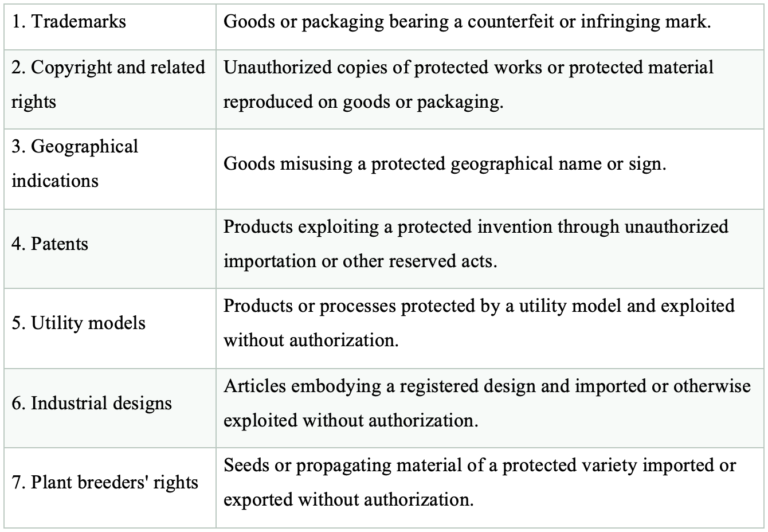
IP Infringing goods mostly appear as below:
The mechanism is provisional and is not, by itself, a final finding of infringement. It is principally preventive, before wider distribution makes tracing and removal more difficult. At the same time, procedural safeguards are equally important so that enforcement does not become an unjustified barrier to legitimate trade.
1. Legal Basis
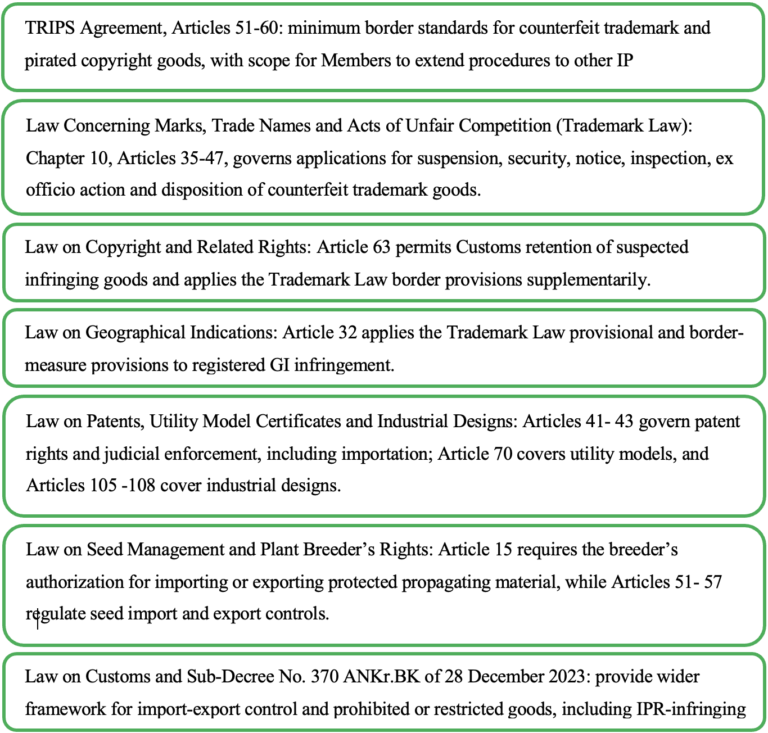
Cambodia’s framework for border measures relating to IP infringement is drawn from international obligations, intellectual property legislation and customs law. The principal sources are:
2. Border Procedure
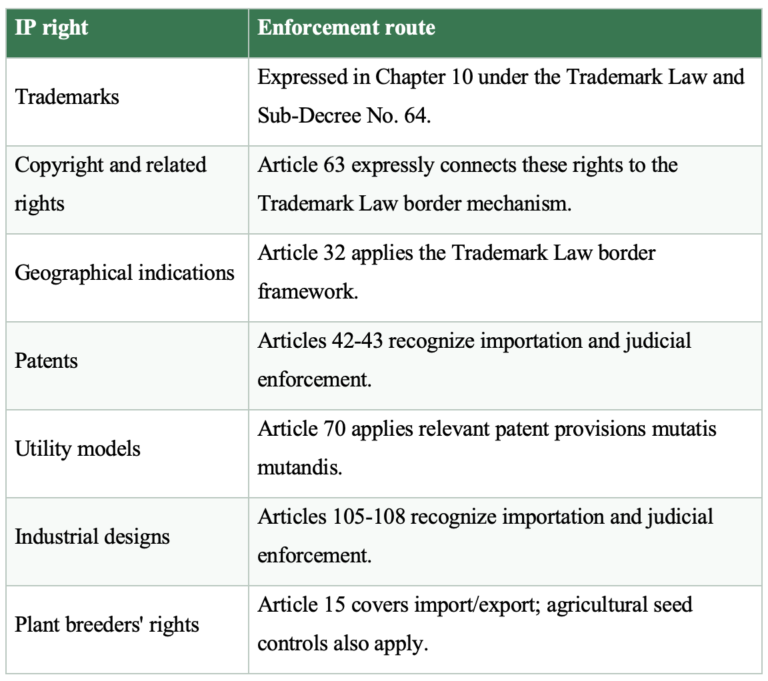
Normally, goods can be controlled while they remain identifiable within the border process. Cross border goods may implicate several IP rights, but in Cambodia not every right uses the same border procedure. Trademarks, copyright and related rights, and geographical indications are expressly linked to the special suspension mechanism; other rights may treat unauthorized trade as infringement but require a different judicial or regulatory route.
Rights on trade names, trade secrets and layout-designs of integrated circuits may also be relevant to cross-border conduct. However, their treatment depends on the specific and applicable law which Cambodia has not officially established yet.
3. Initiating Border Action
The General Department of Customs and Excise of Cambodia remains the central border authority for control of imported and exported goods. Sub-Decree No. 64 also identifies other competent authorities involved in border measures vary according to the all the intellectual property right concerned.
General procedural flow

Identification evidence may include registration certificates, genuine-product references, labels and packaging, serial or product codes, security features and shipment information. Its purpose at the border is provisional identification, not a conclusive determination of infringement.
Specialized institutions may verify ownership, registration or scope of protection:
- Ministry of Commerce for trademarks and GIs,
- Ministry of Culture and Fine Arts for copyright and related rights,
- Ministry of Industry, Science, Technology and Innovation for patents, utility models, industrial designs and plant breeders’ rights,
- Ministry of Agriculture, Forestry and Fisheries is relevant to seed administration and import-export controls.