

Prepared by the Research Team of the Research, Public Awareness and Training Office
I. Acts of Copyright Infringement
In Cambodia, copyright and related rights automatically receive legal protection from the moment a work is created, without the need for registration to obtain protection. However, voluntary registration of a work with the Ministry of Culture and Fine Arts can serve as additional evidence to establish ownership of the work in the event of a dispute. In Cambodia, as Law on Copyright and Related Rights (2003) recognizes the principle of “fair use” which allows the use of a work of authorship without obtaining permission from the copyright owner to a certain extent. This principle aims to ensure a balance between “protecting the rights and legitimate interests of authors or copyright holders” and “promoting the public interest.”
In fact, Violations of the above principle commonly occur in the following forms:
- Unauthorized copying
- Unauthorized reproduction
- Unauthorized distribution
- Unauthorized public performance
- Unauthorized broadcasting
- Unauthorized announcement to public
- Unauthorized public display
- Unauthorized commercial use
- Manufacturing, importing and distributing devices or technologies designed to circumvent technological protection measures or remove electronic management information, etc.
In particular, the unauthorized reproduction of works through the Internet (online-based infringement) remains a challenge in law enforcement in Cambodia Law on Copyright and Related Rights (2003) does not yet contain specific provisions addressing copyright infringements committed through digital platforms or online networks.
II. Parties to Copyright and Related Rights Disputes
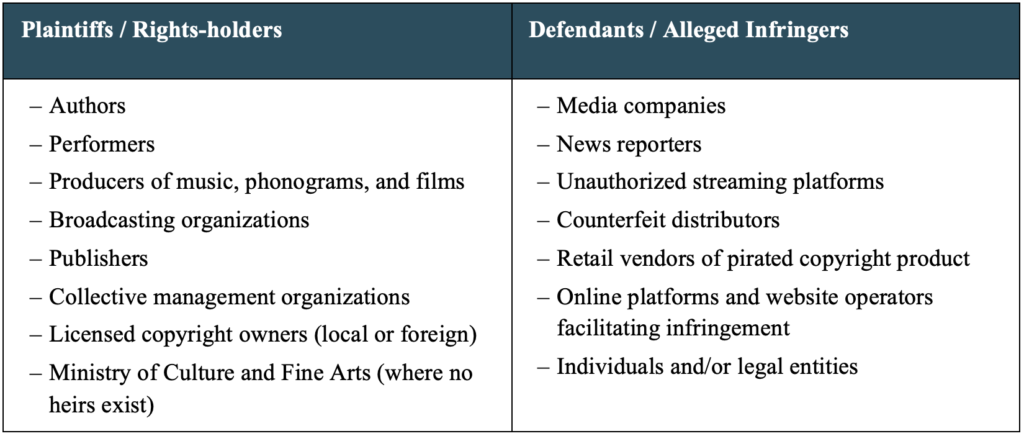
Copyright and related rights infringement may give rise to civil or criminal liability. The parties to the dispute may be:
III. Administrative Enforcement Measures
1. Ministry of Culture and Fine Arts (MCFA)
The Ministry of Culture and Fine Arts is the competent government institution primarily responsible for the administration, recognition, and protection of copyright and related rights, as well as for coordinating the resolution of disputes related to these rights. In addition, the Ministry is also responsible for implementing policies and issuing various legal instruments in accordance with the Law on Copyright and Related Rights. Furthermore, the Ministry may cooperate with relevant competent authorities to prevent and address copyright and related rights infringement issues, as well as facilitate mediation between rights holders and persons accused of infringement in order to achieve voluntary dispute resolution.
Generally, mediation or conciliation between rights holders and persons accused of infringement, facilitated by the Ministry, may result in the following outcomes:
- Upon Successful Conciliation: If the parties reach an agreement, the MCFA will draft a Record of Conciliation or a Dispute Settlement Agreement, which is an administrative document detailing the terms agreed upon by the parties. such as the cessation of infringing activities, the removal or dismantling of illegally used means, the payment of agreed compensation, or other obligations, this document must be signed by all parties and endorsed by a conciliation officer from the Ministry to certify the voluntary resolution of the dispute.
- Upon Failed Conciliation: If the parties are unable to reach an agreement, the MCFA may prepare a record of unsuccessful conciliation to conclude the administrative procedure. Such failure to reach a settlement does not affect the rights of the rights holder to pursue other legal remedies Such as continuing proceedings before the court (civil or criminal) to seek legal protection of rights and compensation under the law.
- Upon Court Request: When a dispute is resolved through judicial proceedings, civil or criminal courts may request the MCFA to provide technical opinions, relevant documents, or copies of conciliation records for use as supporting grounds or evidence in the case. Written opinions or documents issued by the Ministry play an important role in clarifying technical issues, authorship, lawful ownership of works, and the scope of the alleged infringement
2. General Department of Customs and Excise (GDCE)
The GDCE oversees Cambodia is responsible for inspecting the legality of goods crossing Cambodia’s borders and implementing measures to detain goods suspected of being counterfeit upon the request of copyright or related rights holders, in accordance with Article 63 of the Law on Copyright and Related Rights. After the Customs and Excise Administration decides to detain the goods, the Customs and Excise Administration must immediately notify both the importer or holder and the complainant (requestor). Subsequently, the complainant or requesting rights holder must proceed to request a temporary preservation order from the court within 10 (ten) working days. If the rights holder fails to comply with the above requirements within the prescribed period, the customs and excise authorities may lift the detention measures imposed on such goods.
To make this process proactive, the GDCE operates an online Intellectual Property Rights Recordation System (IPRRS). Rights-holders can record their protected copyrights directly into this customs database. This allows frontline border officials to automatically identify, flag, and seize incoming pirated shipments without waiting for a private tip-off.
3. Ministry of Posts and Telecommunications (MPTC) and Anti-Economic Crime Police
Currently, copyright and related rights infringements through physical piracy have gradually been replaced by infringements committed through online platforms and the distribution of works in digital formats. Therefore, copyright infringements occurring through online and digital channels may currently be addressed through joint administrative measures implemented by the Ministry of Posts and Telecommunications and the Economic Crime Police. Both institutions may take direct measures to prevent or block access to domain names of websites and data hosting services that are used without authorization or are involved in copyright infringement.
IV. Alternative Dispute Resolution
Mediation/Conciliation
Conciliation/Mediation is a dispute resolution mechanism that is faster, more flexible, and offers greater confidentiality than court proceedings and in a business sense, it can help maintain relationships or partnerships between parties. The third party may include legal advisors, intellectual property associations, Or private institutions providing mediation services have the role of facilitating communication, conducting conciliation, and encouraging the parties to negotiate in order to reach a solution acceptable to both sides. However, they do not have the authority to make any decisions or impose any resolution.
Mediation generally results in settlement agreements, including undertakings to cease infringement or payment of modest compensation.
If successful, the parties execute a written settlement agreement, which commonly includes cease-and-desist undertakings, payment of compensation, licensing arrangements, confidentiality obligations, and other mutually agreed terms. The settlement agreement constitutes a binding civil contract.
In cases where conciliation or mediation is unsuccessful, or if either party fails to comply with the signed agreement, the other party may pursue legal action, such as proceeding to court.
Arbitration
Copyright disputes arising from contracts, such as disputes related to licensing agreements or royalty payments, may be resolved through arbitration mechanisms. The parties have the right to determine the arbitration procedures, the place of arbitration, the language to be used, and other procedural matters.
An arbitral award or decision rendered by the arbitrator is binding upon the parties and may be submitted to the court for recognition and enforcement in accordance with Article 45 of the Law on Commercial Arbitration. Furthermore, Cambodia is a party to the New York Convention. Therefore, arbitral awards issued by the National Commercial Arbitration Centre of Cambodia may also be recognized and enforced in more than 160 jurisdictions that are parties to the Convention.
V. Measures in Criminal Disputes
Criminal copyright cases are conducted under the Code of Criminal Procedure and heard by the ordinary criminal courts, as Cambodia does not have a specialized criminal IP court. Criminal copyright cases are generally limited to large-scale, commercial, or repeat infringement. A rights-holder may file a complaint prosecutor or the Anti-Economic Crime Police Department to initiate criminal proceedings. If the prosecutor decides not to bring charges, the rights holder may appeal against such decision in accordance with the procedures established by law.
The prosecutor and/or the Department of Economic Crime Police have the authority to investigate acts of infringement through surveillance, inspection, or any covert operations. If sufficient evidence is available, the prosecutor will decide to bring charges in accordance with the provisions of Chapter 11 of the Law on Copyright and Related Rights. Such offenses may be punishable by imprisonment ranging from 1 (one) month to 24 (twenty-four) months and a fine ranging from 1,000,000 (one million) riels to 25,000,000 (twenty-five million) riels. In addition, the court may order the destruction of infringing products, the confiscation of production equipment, and the forfeiture of benefits or profits derived from the commission of such infringement.
VI. Measures in non-criminal disputes
Non-criminal copyright disputes are heard before the civil courts of Cambodia.
Court-ordered Provisional Measures or Injunctions
Under Article 59 of the Law on Copyright and Related Rights, the court may order the implementation of provisional measures to preserve evidence, including conducting searches, seizing infringing copies, and confiscating equipment used to produce such copies, or preventing ongoing or imminent copyright infringements. However, in general, the plaintiff is required to provide a security deposit or other form of guarantee to cover any damages that may arise if the provisional measures are improperly granted.
Please read PIPTA’s Brief Article of “Court-Ordered Provisional Measures Against Intellectual Property Infringements” https://pipta.org.kh/2026/07/04/brief-article-on-court-ordered-provisional-measures-against-intellectual-property-infringement/ .
Civil Lawsuit
Currently, civil cases related to copyright infringement in Cambodia are relatively limited in number, as court proceedings may be time-consuming, and many disputes are resolved amicably, such as through cease-and-desist notices or administrative conciliation mechanisms, act.
Enforcement
After a judgment or court decision becomes finally enforceable (or provisionally enforceable), compulsory enforcement is carried out in accordance with the Code of Civil Procedure and the Law on Copyright and Related Rights. Under Article 66 of the Law on Copyright and Related Rights, the court may confiscate part or all of the income derived from the offense and the equipment used to commit the offense, and may transfer the confiscated equipment or materials to the copyright or related rights holder or order their destruction, among other measures. For judgments requiring monetary payment, compulsory enforcement may be carried out through the seizure of assets, garnishment of bank accounts, or other enforcement measures provided for under the Code of Civil Procedure.