Prepared by the Research Team of the Research, Public Awareness and Training Office.
I. Trademarks
A trademark is a visible sign that distinguishes the goods or services provided by one trader from those provided by others. A trademark may consist of words, drawings, letters, abbreviations, numbers, packaging, slogans, symbols, colors, scents, sounds, or other names, such as surnames, signatures, and emblems, etc. Currently in Cambodia, sound and scent marks are not yet recognized as registrable marks eligible for statutory exclusive rights under the Law Concerning Marks, Trade Names and Acts of Unfair Competition (2002). While some countries have expanded the scope of trademark protection beyond visible signs to recognize signs but also by recognizing signs that can be perceived through various emotions, such as sound and scent. In fact, Australia, South Korea, and Malaysia have incorporated both types of signs into their trademark laws to expand the scope of rights protection for trademark owners. There are also some countries such as China, Japan, and Thailand that recognize voice as trademark, but do not recognize scent for trademark registration.
1. Trademark Registration
The Ministry of Commerce is the competent authority responsible for managing, registering, and protecting trademarks. It is also responsible for carrying out duties related to the procedures for trademark registration and for managing already registered trademarks. An application for trademark registration must be made using the application form prescribed in the Prakas of the Ministry of Commerce and must be signed by the applicant or their legally authorized agent.
Exclusive rights to use a mark are recognized through registration. Therefore, to acquire rights over a mark, the trademark owner must file an application to register that mark in order to establish the legal right to claim statutory protection in the event of an infringement of their exclusive trademark rights.
2. Rights of the Trademark Owner
Under the Law Concerning Marks, Trade Names and Acts of Unfair Competition (2002), the rights of a trademark owner derived from registration include the following:
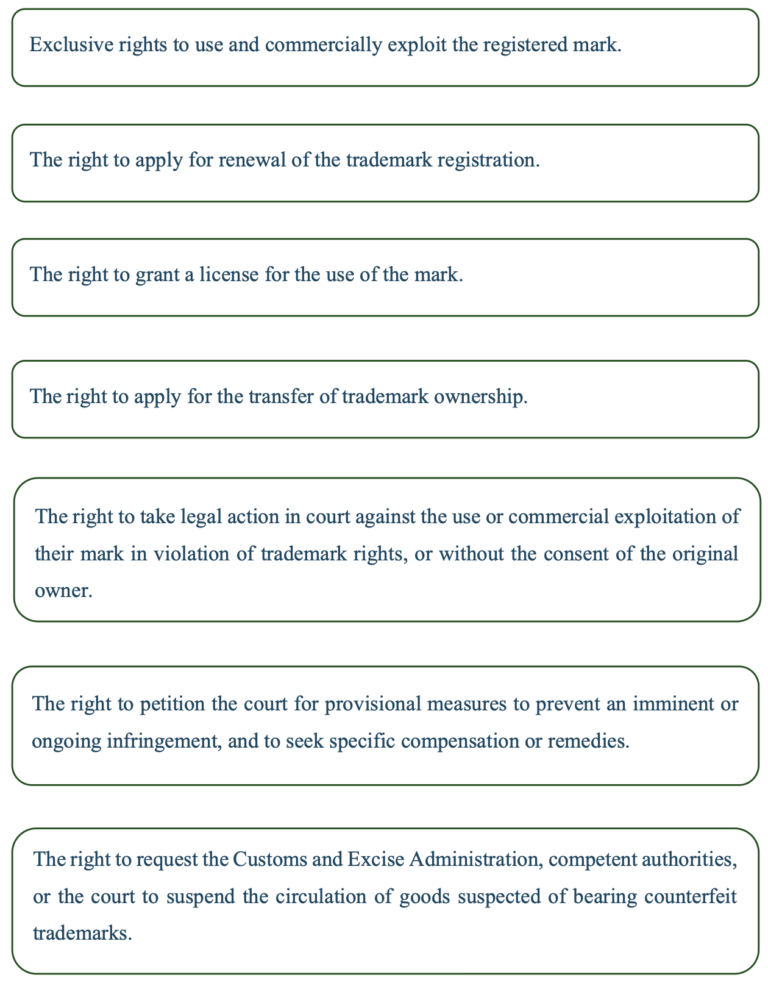
3. Obligations of Trademark Owners
The trademark owner must comply with the legal conditions and procedures to maintain the validity of the registration and the protection of their rights as follows:
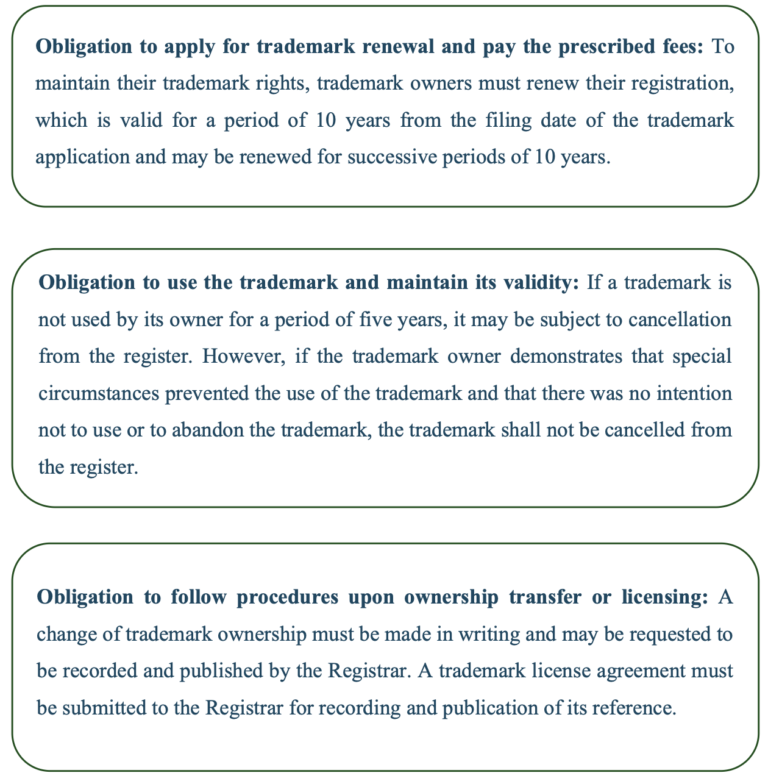
II. Industrial Designs
An industrial design is a combination of lines or colors, or a three-dimensional form, or any material. Whether or not associated with lines or colors, provided that such composition, form, or material gives a special appearance (referring to the visible external appearance of an object or product) to a product of industry or handicraft, and can serve as a pattern for a product of industry or handicraft and is recognizable by sight. An industrial design refers to the overall form of a product and its functional purpose in utilizing that form. An industrial design differs from a trademark because it constitutes the shape of the product itself, whereas a trademark is merely an identifier of a product or service.
1. Industrial Design Registration
An application file for the registration of an industrial design must be submitted to the Ministry of Industry, Science, Technology & Innovation, which is the competent authority responsible for the administration, registration, and protection of industrial designs. An industrial design may be registered if the owner can demonstrate that the industrial design is “new.” A new industrial design is an industrial design that has not been disclosed to the public anywhere in the world prior to the filing date or the priority date of the application (referring to the earliest filing date used as a basis to claim priority rights), by means of tangible visual publication, use, or through any other means of dissemination.
The registration of an industrial design aims to protect the external appearance of a product, whereas the registration of a trademark aims to protect the name, logo, or sign used to identify goods or services.
2. Rights of the Industrial Design Owner
According to the Law on Patents, Utility Model Certificates and Industrial Designs (2003), the rights of the owner of an industrial design obtained from registration include:
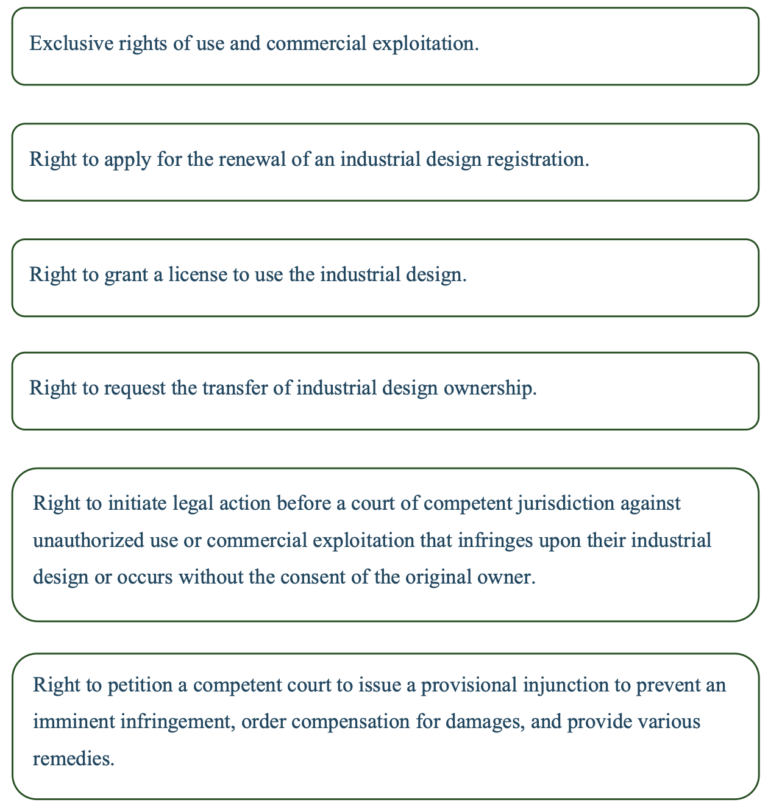
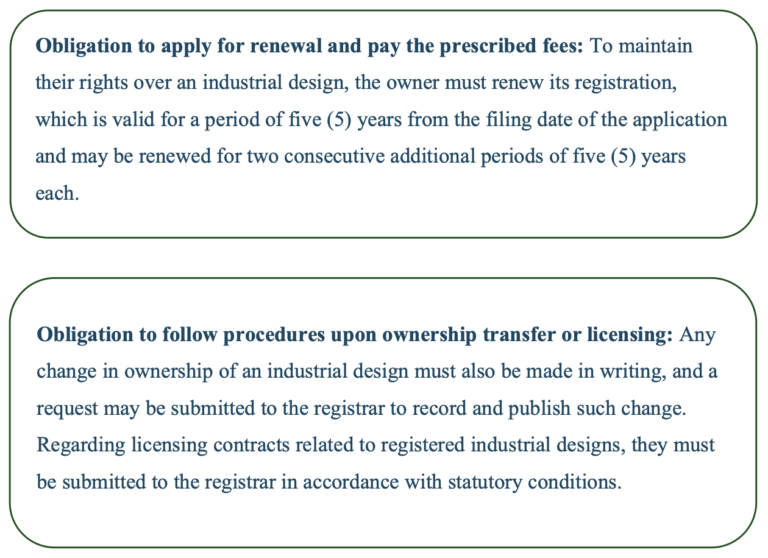
The owner of an industrial design must comply with the conditions and procedures prescribed by law to maintain the validity of the registration and protect their rights, as follows: